FEATURED ARTICLE
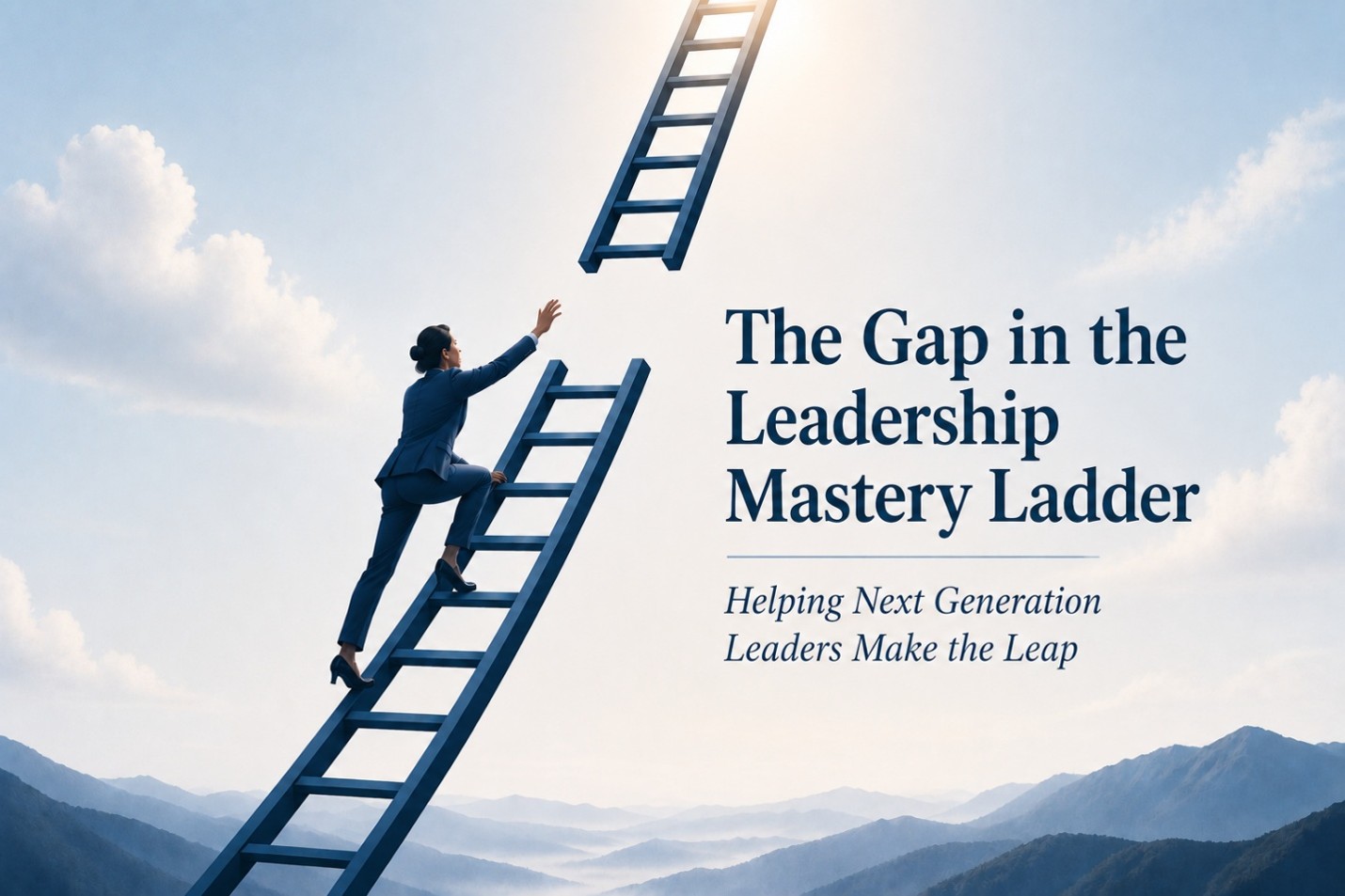
The Gap in the Leadership Mastery Ladder
Helping Next Generation Leaders Make the Leap
What’s Inside
The transition from functional leadership to enterprise leadership requires more than years of experience or greater responsibility. It requires a different level of mastery: the ability to see beyond one function, navigate competing priorities, challenge assumptions, and make decisions with the broader organization in mind. This article explores the gap that can emerge as next-generation leaders approach the executive level and examines how organizations can create the conditions that help leaders make that shift.
Sarah did everything her organization asked of her.
Over twelve years, she’d built a reputation as a high-performing leader. She consistently delivered results, developed strong teams, and became the person others relied on to solve difficult operational problems. When she was promoted to the executive leadership team, it felt like the natural next step.
A few months later, she found herself in her first executive strategy meeting.
She understood, in theory, how the pieces of the organization fit together. She knew that a technology decision could affect talent, that workforce decisions could influence culture and financial performance, and that supply chain challenges could quickly become customer issues.
What caught her off guard was something more subtle.
In this room, understanding the connections wasn’t enough. Sarah was expected to weigh competing priorities, wrestle with difficult tradeoffs, and help make decisions that served the enterprise rather than simply advocating for Operations.
She wasn’t being asked to represent her function anymore. She was being asked to think and decide for the organization as a whole.
Nothing in her previous role had fully prepared her for that shift. Not because she lacked leadership ability, but because she reached a point where a different kind of leadership skill was necessary.
She had reached the gap in the leadership mastery ladder.
The Rung That Changes Everything
For more than fifty years, we’ve seen the profound impact intentional leadership development can have on individuals, teams, and organizations. Organizations invest billions of dollars each year in leadership programs, executive coaching, mentoring, assessments, and on-the-job experiences because they understand that strong leadership shapes culture, performance, and long-term success.
That investment matters. And it works.
But many organizations still face a familiar challenge. They have talented, capable leaders who excel in their own roles, yet they lack clarity on which of those leaders are truly prepared to help lead the organization into the future.
The challenge isn’t due to a lack of potential or talent. It is that organizations often develop leaders right up to a point where the nature of leadership itself begins to change.
Leadership development resembles climbing a mastery ladder. Every meaningful experience adds another rung: delivering results, developing people, building trust, mastering a function, leading through change, and taking on increasingly complex responsibilities.
Most leaders climb it well. Then, near the top, something changes.
The next rung isn’t simply higher. It’s farther away.
The gap represents the transition from becoming an excellent leader of people and functions to becoming an effective contributor to enterprise leadership. It is the point where leaders move beyond optimizing one part of an organization and begin helping steward the success of the entire enterprise. 
And that requires more than a larger title, a broader scope, or more direct reports. Unfortunately, many organizations assume this enterprise leadership shift happens naturally as a byproduct of experience.
It often doesn’t.
Experience Gets You Here. It Doesn’t Get You Across.
Experience matters. But experience alone is an imperfect teacher.
Time in a role does not automatically produce broader perspective or better judgment. Organizations can spend years helping leaders become exceptional within their own team or function without necessarily preparing them to think beyond the boundaries of their own responsibilities. The transition across the gap to next-level mastery requires something different.
Leaders need to develop perspective alongside expertise. They must learn to hold 
competing truths at the same time, appreciate viewpoints beyond their own, think in systems rather than silos, and make decisions that strengthen the organization as a whole. Those capabilities rarely develop in isolation.
They grow when organizations intentionally create experiences where leaders step outside their own perspectives, engage with meaningful enterprise challenges, challenge one another’s thinking, and learn together over time.
Three Ways to Close the Gap
There are no shortcuts to this kind of next-level mastery, but organizations can create the conditions that make it more likely to develop.
Most leaders spend their careers solving the problems that belong to their team or function. Enterprise leaders inherit problems that belong to everyone.
When rising leaders regularly engage with challenges outside their own area, their frame of reference begins to expand. A technology discussion becomes a talent discussion. A finance issue becomes a customer experience issue. A people challenge becomes a strategic decision.
Over time, leaders stop seeing individual issues and begin recognizing systems.
Organizations can create these experiences deliberately through cross-functional projects, enterprise-wide reviews, and working sessions built around challenges outside a leader’s normal area of responsibility.
Many leadership teams spend considerable time sharing updates. Far fewer spend time examining one another’s thinking.
Next-level mastery develops when trusted peers ask questions that challenge assumptions and broaden perspective:
- What are we missing?
- How might another part of the organization experience this differently?
- What are the consequences we haven’t considered?
The goal isn’t to prove someone’s thinking wrong. It’s to make everyone’s thinking stronger.
That kind of dialogue also builds something essential: trust. As leaders work through difficult issues together, they become more willing to admit uncertainty, test incomplete ideas, acknowledge mistakes, and genuinely consider perspectives that challenge their own.
Organizations create this condition by giving leaders regular, structured opportunities to engage in meaningful dialogue rather than simply report on their respective areas.
Executive leadership moves quickly. One difficult decision gives way to the next, and without intentional reflection, valuable learning can disappear in the pace of daily work. Experience becomes more valuable when leaders have a structured way to examine it together.
That means going beyond sharing what happened. Leaders need to unpack important decisions and experiences: What assumptions shaped the decision? What worked and what didn’t? What were the unintended consequences? What would we do differently knowing what we know now? And what can others around the table take from that experience and apply to challenges of their own?
This kind of reflection turns individual experience into shared wisdom. One leader’s difficult conversation becomes another leader’s insight. A challenge in Operations prompts a new way of thinking in Finance. A customer issue changes how another leader approaches talent.
Instead of learning only from their own successes and failures, leaders begin learning from situations they haven’t personally encountered. Over time, the collective experience of the group becomes a resource available to everyone.
And when leaders repeatedly reflect and learn together over time, the trust built through those interactions becomes an important part of the development itself. Years later, when these leaders find themselves sitting around the executive table together, they aren’t beginning to build trust. They are building on an existing foundation.
Back at the Executive Table
Now imagine Sarah returning to that executive strategy meeting, after a year spent working through enterprise challenges, testing her thinking with trusted peers, and learning from their collective experience. The issues aren’t any less complicated. If anything, they are more complex.
What has changed is how she approaches them.
She no longer enters the room primarily representing Operations. She listens for connections across the organization. She asks better questions. She welcomes perspectives that challenge her own. She recognizes that her functional expertise gives her valuable insight, but that it is only one perspective among many. Rather than searching for the best answer for her department, she works with her colleagues to find the best path for the enterprise.
That is the transition organizations are trying to develop in their next generation of leaders.
In an increasingly complex environment, organizations cannot assume this kind of mastery will emerge simply through time, experience, or another individual leadership course. They must intentionally create the conditions where talented leaders learn to think beyond their own functions, challenge one another’s assumptions, broaden their perspectives, and grow together over time.
Organizations that do will not simply develop stronger individual leaders. They will build leadership teams better prepared to steward the future of the enterprise together.
Sarah did everything her organization asked of her.
Over twelve years, she’d built a reputation as a high-performing leader. She consistently delivered results, developed strong teams, and became the person others relied on to solve difficult operational problems. When she was promoted to the executive leadership team, it felt like the natural next step.
A few months later, she found herself in her first executive strategy meeting.
She understood, in theory, how the pieces of the organization fit together. She knew that a technology decision could affect talent, that workforce decisions could influence culture and financial performance, and that supply chain challenges could quickly become customer issues.
What caught her off guard was something more subtle.
In this room, understanding the connections wasn’t enough. Sarah was expected to weigh competing priorities, wrestle with difficult tradeoffs, and help make decisions that served the enterprise rather than simply advocating for Operations.
She wasn’t being asked to represent her function anymore. She was being asked to think and decide for the organization as a whole.
Nothing in her previous role had fully prepared her for that shift. Not because she lacked leadership ability, but because she reached a point where a different kind of leadership skill was necessary.
She had reached the gap in the leadership mastery ladder.
The Rung That Changes Everything
For more than fifty years, we’ve seen the profound impact intentional leadership development can have on individuals, teams, and organizations. Organizations invest billions of dollars each year in leadership programs, executive coaching, mentoring, assessments, and on-the-job experiences because they understand that strong leadership shapes culture, performance, and long-term success.
That investment matters. And it works.
But many organizations still face a familiar challenge. They have talented, capable leaders who excel in their own roles, yet they lack clarity on which of those leaders are truly prepared to help lead the organization into the future.
The challenge isn’t due to a lack of potential or talent. It is that organizations often develop leaders right up to a point where the nature of leadership itself begins to change.
Leadership development resembles climbing a mastery ladder. Every meaningful experience adds another rung: delivering results, developing people, building trust, mastering a function, leading through change, and taking on increasingly complex responsibilities.
Most leaders climb it well. Then, near the top, something changes.
The next rung isn’t simply higher. It’s farther away.
The gap represents the transition from becoming an excellent leader of people and functions to becoming an effective contributor to enterprise leadership. It is the point where leaders move beyond optimizing one part of an organization and begin helping steward the success of the entire enterprise.
And that requires more than a larger title, a broader scope, or more direct reports. Unfortunately, many organizations assume this enterprise leadership shift happens naturally as a byproduct of experience.
It often doesn’t.
Experience Gets You Here. It Doesn’t Get You Across.
Experience matters. But experience alone is an imperfect teacher.
Time in a role does not automatically produce broader perspective or better judgment. Organizations can spend years helping leaders become exceptional within their own team or function without necessarily preparing them to think beyond the boundaries of their own responsibilities. The transition across the gap to next-level mastery requires something different.
Leaders need to develop perspective alongside expertise. They must learn to hold competing truths at the same time, appreciate viewpoints beyond their own, think in systems rather than silos, and make decisions that strengthen the organization as a whole. Those capabilities rarely develop in isolation.
They grow when organizations intentionally create experiences where leaders step outside their own perspectives, engage with meaningful enterprise challenges, challenge one another’s thinking, and learn together over time.
Three Ways to Close the Gap
There are no shortcuts to this kind of next-level mastery, but organizations can create the conditions that make it more likely to develop.
1. Put Leaders in Problems They Don’t Own
Most leaders spend their careers solving the problems that belong to their team or function. Enterprise leaders inherit problems that belong to everyone.
When rising leaders regularly engage with challenges outside their own area, their frame of reference begins to expand. A technology discussion becomes a talent discussion. A finance issue becomes a customer experience issue. A people challenge becomes a strategic decision.
Over time, leaders stop seeing individual issues and begin recognizing systems.
Organizations can create these experiences deliberately through cross-functional projects, enterprise-wide reviews, and working sessions built around challenges outside a leader’s normal area of responsibility.
2. Let Other Leaders Complicate Their Thinking
Many leadership teams spend considerable time sharing updates. Far fewer spend time examining one another’s thinking.
Next-level mastery develops when trusted peers ask questions that challenge assumptions and broaden perspective:
• What are we missing?
• How might another part of the organization experience this differently?
• What are the consequences we haven’t considered?
The goal isn’t to prove someone’s thinking wrong. It’s to make everyone’s thinking stronger.
That kind of dialogue also builds something essential: trust. As leaders work through difficult issues together, they become more willing to admit uncertainty, test incomplete ideas, acknowledge mistakes, and genuinely consider perspectives that challenge their own.
Organizations create this condition by giving leaders regular, structured opportunities to engage in meaningful dialogue rather than simply report on their respective areas.
3. Help Leaders Turn Experience Into Shared Wisdom
Executive leadership moves quickly. One difficult decision gives way to the next, and without intentional reflection, valuable learning can disappear in the pace of daily work. Experience becomes more valuable when leaders have a structured way to examine it together.
That means going beyond sharing what happened. Leaders need to unpack important decisions and experiences: What assumptions shaped the decision? What worked and what didn’t? What were the unintended consequences? What would we do differently knowing what we know now? And what can others around the table take from that experience and apply to challenges of their own?
This kind of reflection turns individual experience into shared wisdom. One leader’s difficult conversation becomes another leader’s insight. A challenge in Operations prompts a new way of thinking in Finance. A customer issue changes how another leader approaches talent.
Instead of learning only from their own successes and failures, leaders begin learning from situations they haven’t personally encountered. Over time, the collective experience of the group becomes a resource available to everyone.
And when leaders repeatedly reflect and learn together over time, the trust built through those interactions becomes an important part of the development itself. Years later, when these leaders find themselves sitting around the executive table together, they aren’t beginning to build trust. They are building on an existing foundation.
Back at the Executive Table
Now imagine Sarah returning to that executive strategy meeting, after a year spent working through enterprise challenges, testing her thinking with trusted peers, and learning from their collective experience. The issues aren’t any less complicated. If anything, they are more complex.
What has changed is how she approaches them.
She no longer enters the room primarily representing Operations. She listens for connections across the organization. She asks better questions. She welcomes perspectives that challenge her own. She recognizes that her functional expertise gives her valuable insight, but that it is only one perspective among many. Rather than searching for the best answer for her department, she works with her colleagues to find the best path for the enterprise.
That is the transition organizations are trying to develop in their next generation of leaders.
In an increasingly complex environment, organizations cannot assume this kind of mastery will emerge simply through time, experience, or another individual leadership course. They must intentionally create the conditions where talented leaders learn to think beyond their own functions, challenge one another’s assumptions, broaden their perspectives, and grow together over time.
Organizations that do will not simply develop stronger individual leaders. They will build leadership teams better prepared to steward the future of the enterprise together.
Recent News and Insights
Six Creative Ways Leaders Show Gratitude at Work
UNDERSTANDING LEADERSHIP Six Creative Ways Leaders Show Gratitude at Work Demonstrating thankfulness for our colleagues and team members is an important part of being a great leader; it builds positive working relationships and a healthy organizational culture. Read...
Listen Like You Mean It
As you work towards honing your listening skills, these first steps will put you on the right track, but sustained listening requires ongoing practice, even for the best listeners.
No Matter the Conditions, Selecting Talent Is Hard
No Matter the Conditions,Selecting Talent Is Hard by Jon Player, JD, MSPHPeople are the most important asset in any organization. Finding, growing, and retaining an effective team contributes tremendously to your bottom line—the costs of not doing so can be...