TRAINER TALK
Jon Player
Over the years, I’ve come to believe the Bell Achiever Model™ offers a unique way of thinking about how leaders build trust.
As an Achievers grad, you know the value of working to strengthen your Core Competencies while reducing the influence of your Extreme Personality Patterns. Interestingly, that work creates a connection between personal growth and inspiring trust as a leader.
What’s Inside
Trust isn’t built by being a perfect leader. It’s built in working toward continual improvement. In this article, we explore how Achievers™ principles connect personal growth with the trust we earn from others. By strengthening our Core Competencies and reducing the influence of our Extreme Personality Patterns, we can become more consistent, more responsive to others, and more effective leaders. The result? Trust that grows naturally as we build ourselves.
Central to Achievers is that all leaders feel the pull of Extreme Personality Patterns, especially when under pressure. As we continue building our leadership skills, Extreme Personality Patterns are less likely to become our default behaviors. Our built Core Competencies supplement those tendencies and produce healthier, more successful leadership behaviors.
Instead of allowing our own psychological needs to drive behavior, we become increasingly able to respond to what the situation and the people around us actually need.
Over time, that difference profoundly shapes whether others come to trust us.
The Hidden Barrier to Trust
You’ve probably experienced leaders who allow their extremes to dominate their behaviors:
 A leader subtly positions themselves as the driving force behind a successful project. Their recognition quietly becomes more important than making sure everyone else feels valued.
 Another leader delays an important performance conversation because avoiding discomfort feels easier than addressing the issue. Their team experiences something very different. They begin wondering whether everyone has the same standard.
 A third leader holds tightly to important decisions because maintaining control feels safer than allowing others to take ownership. Before long, initiative disappears as trust erodes.
On the surface, these behaviors look very different. Underneath, they all share a key dynamic. The leader’s attention has moved inward, away from what the people around them and the situation requires, toward meeting their own needs.
That is often where trust begins to erode.
Why Achiever Leaders Earn Trust
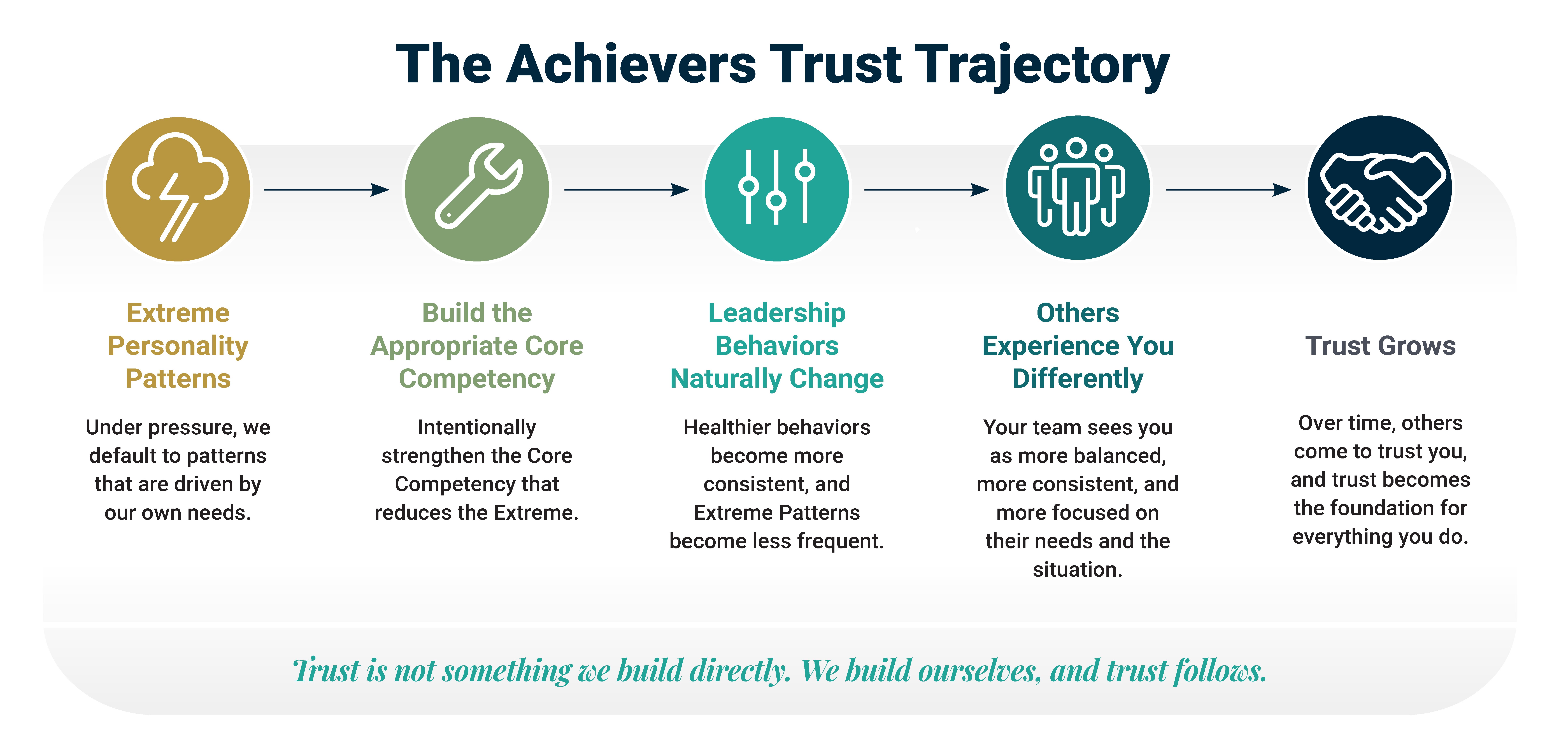
One of the most important lessons of Achievers is that reducing an Extreme Personality Pattern isn’t simply a matter of trying harder not to behave that way. Instead, it comes from intentionally building the Core Competency that compliments and counteracts that tendency.
As that Core Competency develops, your leadership naturally begins to change. The behaviors associated with the Extreme Personality Pattern become less frequent, while the more effective leadership behaviors associated with the Core become more consistent.
Over time, your team witnesses the impact of those changes. They experience a leader who is more consistent, more balanced, and more able to listen well. A leader’s focus shifts outwards more naturally putting the needs of the team and the organization ahead of their own immediate needs. This shift from inner to outer focus provides the foundation on which trust can be formed.
One of the insights I appreciate most about the Achiever model is that trust isn’t something we build directly. When we build ourselves, trust follows.
Why Trust Deserves Our Attention
Does trust really matter? As the workplace continues to change at a remarkable pace, the answer is resoundingly “yes.”
Organizations are flatter. Teams move more quickly. Artificial intelligence is reshaping workflows.
Employees are being asked to adapt continually to new technologies, changing priorities, and greater uncertainty.
Those realities make trust more difficult to build and maintain, and thus, increasingly valuable.
Formal authority can establish accountability, but it cannot create commitment. People are far more willing to embrace change, contribute ideas, collaborate openly, and navigate uncertainty when they trust the person leading them.
Fundamentally, a leader’s job is to help people work hard, work smart, and work together. Trust creates the foundation that makes all three possible.
Continuing to Build Yourself
If you begin noticing that your team has become quieter, less willing to challenge your thinking, slower to take initiative, or more hesitant to bring forward difficult issues, resist the temptation to focus first on changing your team.
Instead, begin with yourself.
Ask, “How might my own leadership behaviors be contributing to what my team is experiencing?”
That question reflects one of the central ideas of Achievers. Leadership always begins by building yourself.
The work of building yourself creates the conditions that allow trust to grow. It’s as simple, and as difficult, as that. As you continue strengthening your Core Competencies, you’ll naturally become the kind of leader others experience as more balanced, more consistent, and more trustworthy. As trust grows, so does your ability to lead effectively.
Ultimately, trust is not something you demand or even deliberately pursue. It is something you earn as a byproduct of building yourself.
Want to Build a Stronger Team Through Trust?
Bell Leadership Achievers™ helps leaders learn together, strengthen relationships and build the trust that drives stronger teams and greater results.