
TRAINER TALK
Susan Gisler

A couple of years ago, I started working with a senior executive who had just come through a major change initiative. The plan had been solid going in. But the rollout hit roadblock after roadblock with resistance showing up in places she hadn’t expected. The initiative ultimately took far longer than it should have. On paper, she knew the plan was solid and should have worked. She suspected the real issue lay somewhere deeper.
The more we talked, the clearer it became that her team had chosen not to bring her information at critical points in the project. It also became evident that they hadn’t been hiding things out of carelessness or disengagement. As a new leader to the company, the team had been quietly assessing whether they could trust her. Was she truly capable of hearing hard news? Did she care enough to sit with a problem instead of rushing past it? Would telling her something difficult cost them anything? They never asked those questions explicitly, but their behavior was demonstrated by what they chose to share, what they held back, and how much they revealed in any given conversation.
She wanted to grow as a leader, so instead of starting with the technical side of the next initiative, we took a hard look at her relationships with her team: what was working and what wasn’t. From there, we focused on listening as a skill she could thoughtfully build. She started paying closer attention to what she was hearing and, just as often, to what she wasn’t. It turned out that listening, real and practiced, was the thing her relationships had been missing.
The dividends turned out to be bigger than expected. When the next larger initiative came around, the difference showed up early. People raised concerns while there was still room to adjust course. Her team had decided, somewhere along the way, that she had earned their trust.
Trust is earned in dozens of small moments, not one big one
Most leaders readily accept that trust matters. What’s less understood is how trust is built. It isn’t a single event, a well-timed apology, or a leadership offsite designed to build rapport. Trust accumulates through ordinary interactions, one relationship at a time, built and rebuilt in moments most leaders never think to notice. And the mechanism underneath nearly all of those moments is listening.
This is where many leaders run into trouble. Everyone agrees listening matters. But it is a skill few leaders ever master.
What people are quietly testing before they trust you
Think about how frequently people hand you something true and uncomfortable without first checking, even unconsciously, whether it’s worth the risk. Before someone brings a leader a real concern, an unpopular idea, or an admission of uncertainty, they’re internally running through three questions:
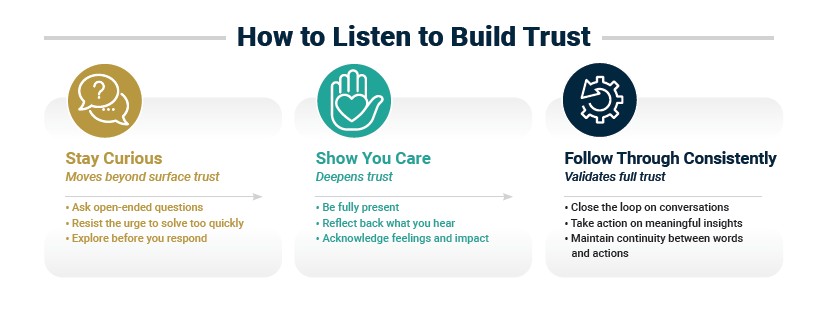
- Can this person actually hear this? Some leaders are visibly impatient, distracted, or already forming a response before the other person finishes a sentence. People notice immediately, and they filter what they’re willing to say.
- Do they care enough to hold space? A leader can hear the words and still communicate, through tone or timing, that the conversation is an interruption rather than something worth their full attention. People feel the difference between being placated and being understood.
- Can I trust them with it? Once something difficult has been shared, what happens next typically matters more than the conversation itself. Was it used constructively, or did it quietly become a liability for the person who raised it?
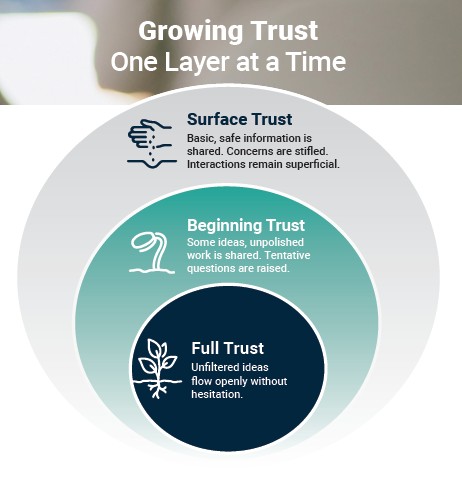
Before someone tells you something of importace, they navigate three levels of trust. Reach the first level, and someone will begin to feel comfortable sharing real information. Reach the next level, and they’ll start bringing you ideas before they’re fully developed or polished. At the final level, you enter a realm of true, deep, and open collaboration. Fail to move through any one of the levels, and the conversation moves back to the surface, which could be a lost opportunity to hear what’s really going on, deepen trust, and build a relationship.
Once someone decides a leader isn’t fully committed to the conversation, they hesitate to go further. They give the safe answer…
Why most leaders stall at the surface
The challenge is that most leaders are rewarded for solving problems quickly, not for sitting with them. As responsibilities grow, conversations start to feel like something to get through rather than something to be in. None of this looks like poor listening from the outside. It can actually look like decisiveness, efficiency, and even strength.
But the people on the other side of those conversations notice the difference. It’s the leader who’s already nodding before they’ve finished a sentence, the quick solution offered before the real problem was fully on the table, and the conversation that feels like it’s being managed rather than had.
Once someone decides a leader isn’t fully committed to the conversation, they hesitate to go further. They give the safe answer, a polished version, or an update that won’t cause trouble, and the leader walks away thinking the conversation went fine.
The real value of better listening
Leaders who master the listening skills necessary to move people to deeper levels of trust get access to information their peers never hear. Not because they’re more likable or more senior, but because their teams have decided, through repeated small interactions, that it’s safe to bring them the truth. That access shows up as fewer surprises, faster course corrections, and decisions made with better information earlier in the process.
The executive I mentioned at the start invested significant time and effort into building her relationships with her team through better listening. And when the next change initiative came around, her team brought her better information, earlier, vastly improving the project’s timeline and outcomes.
Your people decide whether to trust you with the truth long before you ever start to speak. Leaders who understand this, and who put in the quiet, steady work of building their ability to truly listen, see that investment pay off with an outsized return: a team willing to tell them what they most need to know.
Want to deepen leadership capacity through listening and other communication skills?
Bell Leadership’s Advanced Communication program fosters the practical skills that build trust and amplify influence for greater organizational impact.